Discovery
Green and White Tomato Leaves Point to an Enzyme Gene
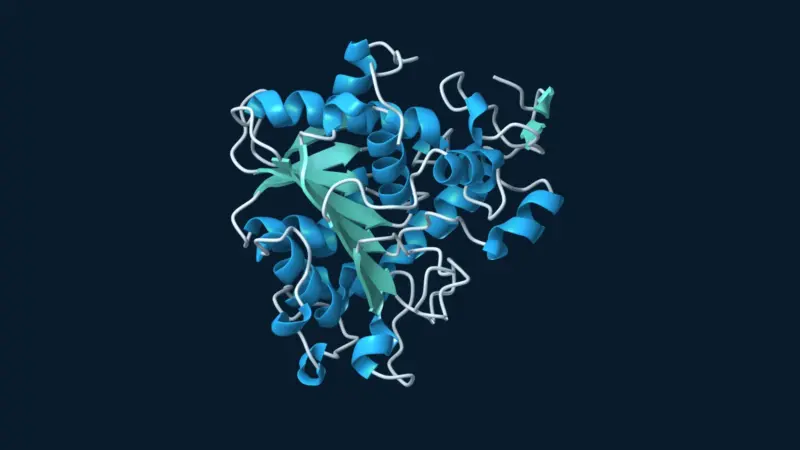
A 2024 study explored the genetics and cell biology behind a tomato plant's patchy leaves. It identified an FtsH-related candidate, with key tests still needed.
The science of enzymes. The possibilities they create.
Explore EnzymeNews
Browse the complete EnzymeNews collection of research reports and explainers, from enzyme mechanisms and medical research to recycling, industrial biocatalysis and AI tools.
Choose a topic, follow a research path below, or browse the stories by their original publication date. Dated update notes explain substantial revisions to older reports. Each article links to its evidence and distinguishes experimental findings from established applications.
36 results
A 2024 study explored the genetics and cell biology behind a tomato plant's patchy leaves. It identified an FtsH-related candidate, with key tests still needed.
How does an enzyme’s performance change from one plastic to another? A new study in Biotechnology Journal, published in April 2024, compares four bacterial enzymes—DaPUase,…
A ligase from a bacteriophage can efficiently attach DNA to the normally difficult 5′ end of RNA. Researchers demonstrated a possible adapter-ligation application, with broader…
A laboratory system linked solar-powered CO2 conversion to enzyme reactions that produced L-sorbose. The result demonstrates a synthesis route, with important resource and efficiency limits.
Two bacterial enzymes can remove much of the blood group A signal from the blood vessels of donated human kidneys.
A 2024 study combined AI sequence generation with laboratory tests to design heat-tolerant GAPDH enzymes. The results show both promising variants and the limits of…
The PAZy database helps researchers trace evidence for plastic-degrading enzymes, distinguish tested proteins from predictions and compare experimental conditions.
Artificial intelligence helped researchers identify an enzyme target and design a drug candidate for idiopathic pulmonary fibrosis (IPF), a disease in which scarring progressively damages…
Researchers used CRISPR to change the composition and colour of a food fungus. The results show what pathway engineering can achieve—and what remains untested.
Patterns in natural protein sequences can help models suggest enzyme changes. A review explains the opportunity, the limits of prediction and why experiments matter.
A chemically modified lipase worked in a heated ionic liquid to break down PLA. The study separates plastic solubilisation from conversion into lactic acid.
A one-cow experiment detected human insulin-related protein in milk. Low output and analytical limits separate this proof of concept from a manufacturing process.