Attaching a short piece of DNA to RNA can help researchers analyse genetic material. The difficulty depends on which ends are being joined. A study published in 2024 introduced R2D ligase, an enzyme that efficiently connects DNA to either end of RNA when complementary DNA strands hold the pieces in position.
The work, led by researchers at ArcticZymes Technologies and published in Biotechnology Journal, describes a ligase from Cronobacter phage CR9. Its most distinctive result concerns the 5′ end of RNA, a junction that the other tested enzymes handled much less efficiently. Original study.
Why the direction of joining matters
DNA and RNA strands have chemically different ends, called 5′ and 3′. Ligases connect adjacent ends by forming a bond in the nucleic-acid backbone. A complementary DNA strand, known as a splint, can align the pieces and present a suitable junction to the enzyme.
Other ligases could already work with several DNA–RNA arrangements. The advance was more specific than discovering that DNA and RNA could be joined at all: R2D efficiently attached DNA to the RNA’s 5′ end under the tested conditions, as well as supporting attachment at its 3′ end.
That flexibility can matter when an adapter or another sequence needs to be added at a particular position. The main comparisons used DNA splints; they do not establish equivalent performance for every possible RNA-containing substrate.
R2D ligase joins two adapters in one mixture
The team compared enzymes using a panel of short nucleic-acid substrates. R2D was the only enzyme tested that efficiently completed all four DNA-splinted combinations highlighted in the study.
The researchers then tested whether DNA adapters could be attached to both ends of a microRNA-like molecule in a single mixture. Different fluorescent labels distinguished the products. More than 70% substrate turnover was reported for both adapters, providing a proof of concept for making DNA–RNA–DNA molecules.
The experiment used defined substrates. A complete sequencing workflow would still need assessment with diverse biological samples, including tests of sequence bias, sensitivity and compatibility with later processing steps.
More ATP was not always better
R2D ligase uses ATP, but more ATP did not improve every reaction. For the difficult DNA-to-5′-RNA junction, lower ATP reduced accumulation of an adenylated intermediate that had failed to complete strand joining.
The result makes reaction conditions part of the enzyme’s practical value. ATP and metal-ion concentrations need to suit the junction being joined; the benefit observed here is not a general rule that reducing ATP improves every ligation reaction.
What could the enzyme enable?
The authors proposed applications in microRNA analysis, RNA sequencing and the preparation of mixed DNA–RNA molecules. The ability to attach sequences at either end could give researchers more flexibility when designing those workflows. The paper did not demonstrate improved gene editing in cells or a therapeutic benefit.
Commercial context is relevant. Several authors were employees of ArcticZymes, which supplies R2D ligase, and the paper discloses patent interests among the authors. These relationships should accompany the findings when their wider usefulness is discussed.
Ligases complement other enzymes in the molecular-biology toolkit. While ligases join existing pieces, polymerases extend strands by copying a template. Our guide to long-range DNA polymerases examines that different task.
Update note, 27 September 2026: This archived report was revised to explain the specific ligation advance, the role of DNA splints, the experimental limits and disclosed commercial interests. Its original publication date and URL are retained.
References
- Gundesø, S. E., et al. (2024). R2D ligase: Unveiling a novel DNA ligase with surprising DNA-to-RNA ligation activity. Biotechnology Journal, 19, 2300711. DOI: 10.1002/biot.202300711.
Image sources
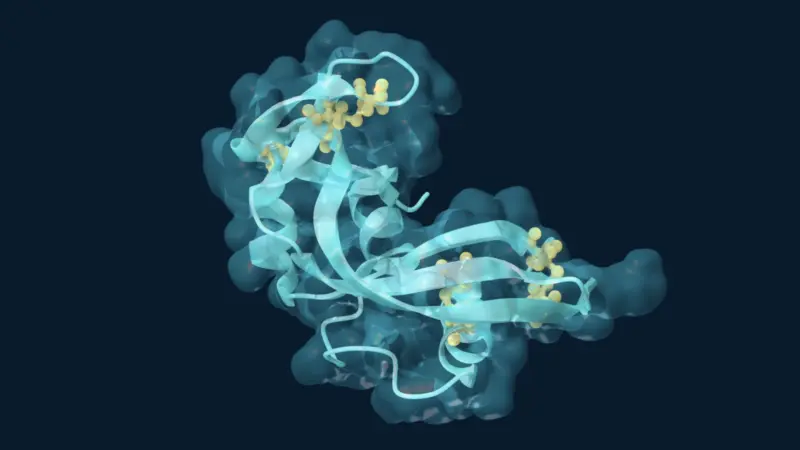
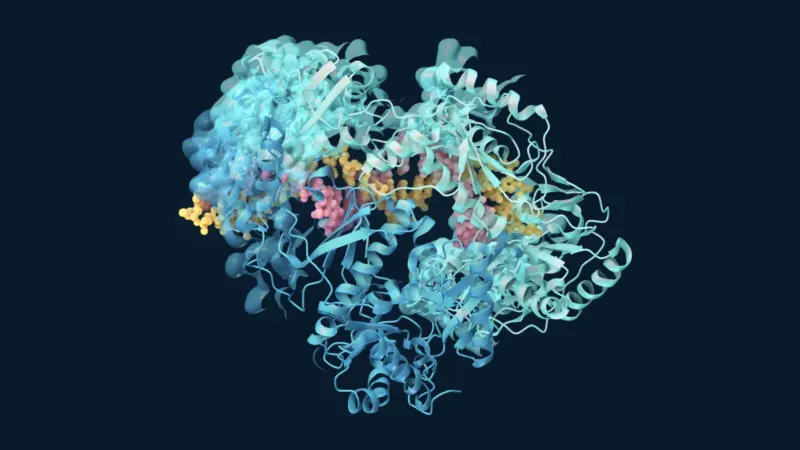
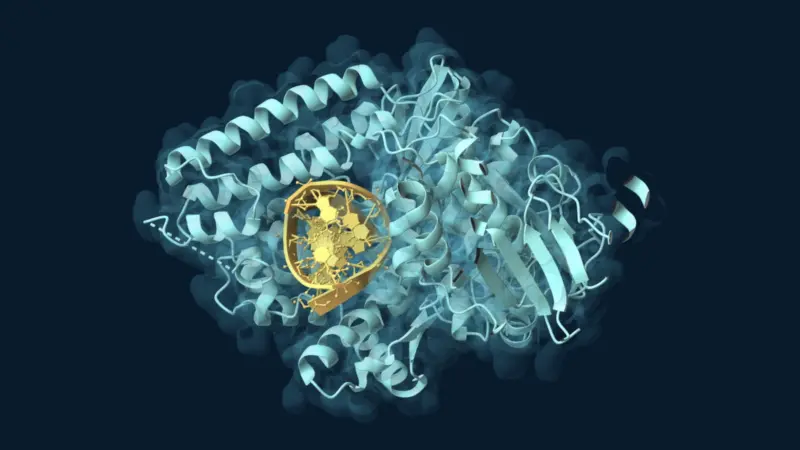
- Structure: PDB 1FIX, a complementary RNA–DNA duplex used here to illustrate hybrid nucleic acids. It is not R2D ligase, a ligation product or one of the substrates tested in the 2024 study. Horton, N. C. and Finzel, B. C. (1996). The structure of an RNA/DNA hybrid: a substrate of the ribonuclease activity of HIV-1 reverse transcriptase. Journal of Molecular Biology, 264, 521–533. DOI: 10.1006/jmbi.1996.0658.
- Visualization: original EnzymeNews rendering with Mol*, using RCSB PDB coordinate data. RNA is blue and DNA is teal; water is omitted.