Few people recognise the name Taq polymerase. Millions recognise the technology it helped make practical: PCR, the method that turns a tiny amount of genetic material into enough DNA to examine.
Behind that familiar abbreviation is an enzyme with an unusual qualification. It can keep working after bursts of heat that would disable many other proteins. That toughness helped transform DNA copying from a demanding process into something a machine could repeat automatically.
The path to that machine runs through hot springs, an enzyme study published years before PCR, and a Nobel Prize awarded for a method. Taq polymerase ties those stories together. It also shows how a discovery can become indispensable long before its name reaches a general audience.
Life where the water is too hot
When Thomas Brock and Hudson Freeze investigated heat-loving microbes, they were exploring how life survives in extreme environments. Their 1969 paper described Thermus aquaticus, a bacterium isolated from thermal springs, including sites in Yellowstone National Park.
The bacterium’s name later supplied the shorthand “Taq”. Its discovery belonged to basic microbiology: understanding an organism and the conditions it could tolerate. The researchers were not unveiling a ready-made DNA test.
For a cell to live in hot water, its internal machinery has to function there. That requirement makes such organisms interesting sources of enzymes. A protein that operates comfortably in a bacterium’s hot environment may have properties that become useful somewhere very different.
That possibility took a more concrete form in 1976. Alice Chien, David Edgar and John Trela reported purifying a DNA polymerase from T. aquaticus. It showed its greatest activity at a high temperature in their experiments. The work established an enzyme worth studying in its own right, before PCR gave heat resistance an entirely new job.
What a DNA polymerase actually does
A DNA polymerase builds DNA using an existing strand as a guide. If the guide carries an A at a position, the new strand needs a T opposite it; a G calls for a C. The enzyme joins the incoming building blocks into a growing chain. It builds from the primer’s growing end, extending new DNA in the direction scientists call 5′ to 3′.
The process needs a starting point. A short piece of DNA called a primer provides one. In PCR, a pair of primers helps define the region to be copied, allowing a chosen stretch to become much more abundant than the surrounding material.
The National Human Genome Research Institute’s explanation of PCR describes the repeating principle. Heat separates the two strands of DNA. Cooling allows the necessary short pieces to bind. A polymerase then builds new strands. The products become guides for subsequent rounds, so the number of copies can rise rapidly.
The primers set the eventual boundaries, rather than acting as stop signs for Taq. Early copies can extend beyond the selected region; repeated cycling produces fragments bounded by both primers.
Under idealised doubling, ten rounds would turn one starting molecule into about a thousand copies. Real reactions are less tidy and eventually slow down. Even so, repeated copying can make an initially scarce DNA sequence accessible to analysis.
Watch PCR in motion
Follow a long DNA molecule through heating, primer binding and copying. Gold marks the primers and peach marks newly built DNA. The first copies extend beyond the selected region; repeated cycles produce fragments whose boundaries are set by both primers.
The obstacle was the heat
PCR uses heat to separate DNA strands. That creates a problem when the enzyme doing the copying cannot survive the heating step. Early PCR work used an enzyme that had to be replenished as the cycles proceeded, adding labour to a process built around repetition.
Taq changed the practical balance. Its resistance to heat meant an enzyme could remain in the reaction while the temperature rose and fell. The useful property was not merely that it made DNA. Many polymerases could do that. It was able to make DNA within a workflow that repeatedly subjected the mixture to disruptive heat.
In a 1988 paper, Randall Saiki and colleagues at Cetus reported PCR using a thermostable polymerase from T. aquaticus. The work demonstrated major gains in practicality and amplification performance. The author list included David Gelfand, Susanne Stoffel, Kary Mullis and other members of the team.
A machine that repeatedly changes temperature could now do much of the cycling work. That made PCR easier to repeat and helped it travel far beyond the group developing it. An environmental adaptation had become a solution to an engineering bottleneck.
The Nobel connection, precisely
Kary Mullis received half of the 1993 Nobel Prize in Chemistry for inventing the PCR method. The other half went to Michael Smith for work on site-directed mutagenesis, a separate way of introducing chosen changes into genetic material.
The award was not a prize for discovering Taq polymerase. Brock and Freeze’s microbiology, Chien and colleagues’ enzyme work, and the Cetus team’s development of thermostable PCR were distinct contributions. Keeping those contributions visible explains how the celebrated method became a practical tool.
This is one of the recurring themes in the history of enzymes and Nobel Prizes: the public remembers a breakthrough by a short name, while the working technology carries a much larger scientific inheritance.
A closer look at the copying machine
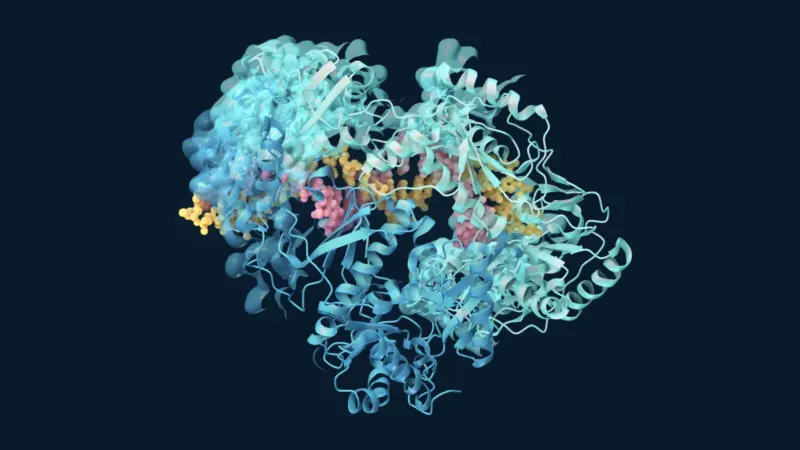
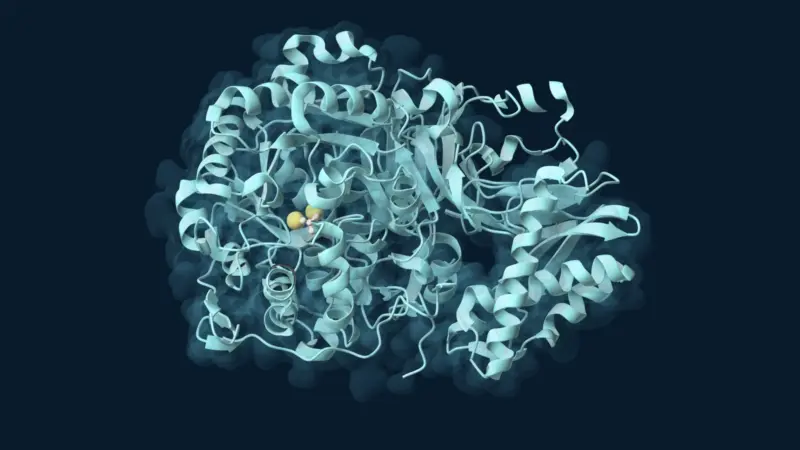
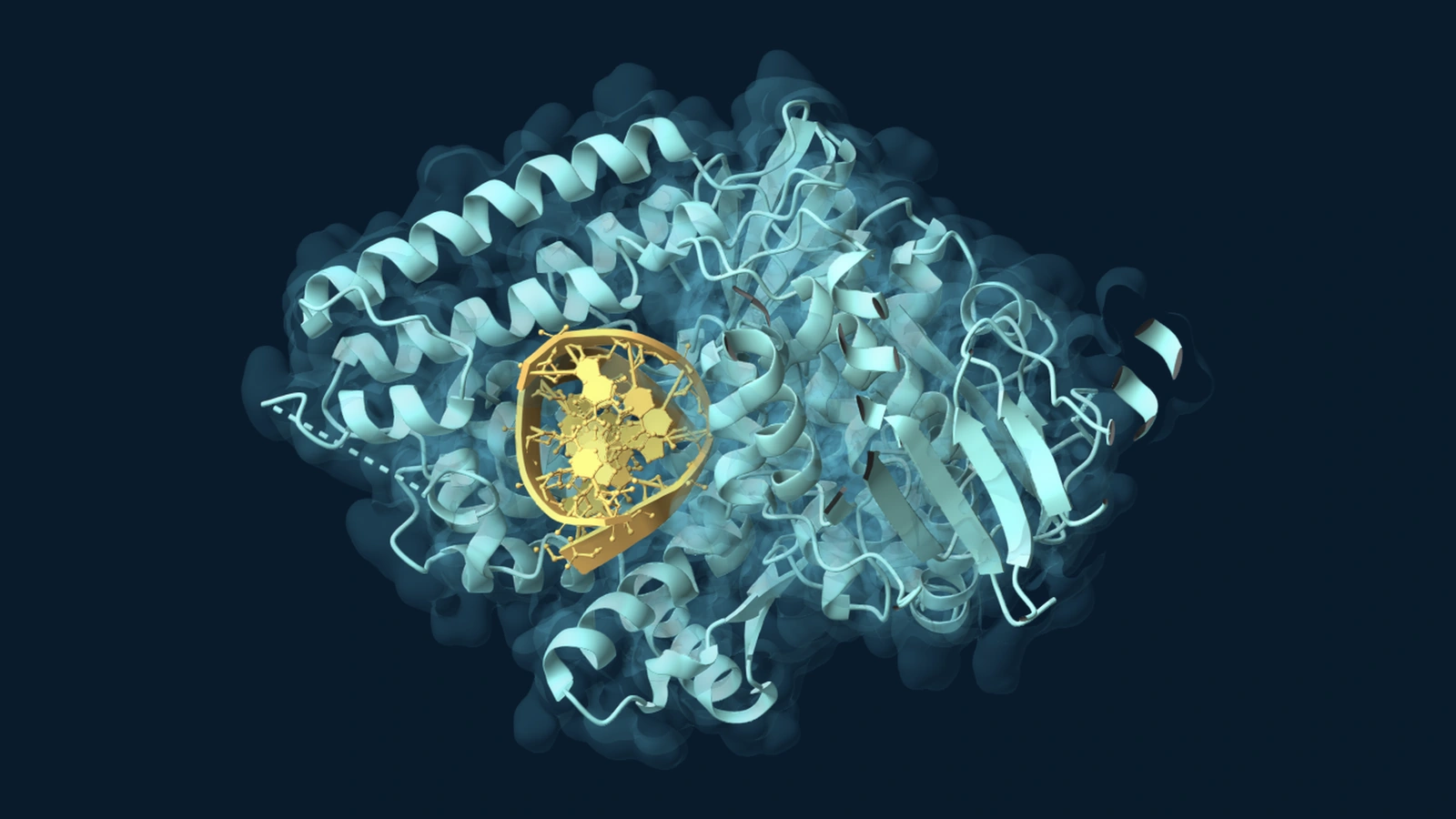
The molecular image accompanying this article is based on PDB structure 1TAU, an experimental structure of Taq polymerase bound to a short piece of double-stranded DNA. The DNA sits at the enzyme’s polymerase site, where copying chemistry takes place.
Structural biologists often describe the polymerase region using the language of a hand: palm, fingers and thumb. The comparison helps locate different parts of the protein around its DNA partner. It is a way to understand shape, rather than a claim that the molecule moves like a human hand.
A structure is also a selected view. This one contains short, blunt-ended DNA and represents a binding arrangement captured for study. It does not show a complete PCR cycle, a moving enzyme or every intermediate in DNA synthesis.
Our animation uses that fixed protein shape as a structural reference, with separately modeled long DNA and simplified movements to explain the copying cycle.
Powerful copying still needs careful interpretation
Taq lacks the 3′-to-5′ proofreading activity that allows some other polymerases to remove an incorrectly added DNA letter. A comparison of thermostable polymerases demonstrated differences in copying fidelity, including higher fidelity for Pfu than Taq under the conditions tested. Researchers therefore choose enzymes to suit the question, especially when the precise sequence of every copied molecule matters.
Amplification also magnifies whatever matching DNA enters a reaction, including unwanted contamination. Producing a signal and interpreting its meaning are separate responsibilities. Controls, sampling and the design of the test matter alongside the copying enzyme.
PCR now supports genetic research, forensic analysis and many diagnostic methods. Different applications use different polymerases and formulations; a modern PCR result does not necessarily mean the original Taq enzyme did all the work. Its historical contribution was to make repeated heat-driven copying remarkably convenient.
A bacterium adapted to hot water did not evolve to serve a laboratory. Scientists recognised a useful property and carried it into a new setting. Inside countless DNA experiments, that unlikely journey is still easy to miss.
Sources and further reading
- Brock and Freeze (1969): description of Thermus aquaticus.
- Chien, Edgar and Trela (1976): purification of a heat-stable DNA polymerase.
- Saiki and colleagues (1988): PCR with a thermostable DNA polymerase.
- Nobel Prize in Chemistry 1993: official explanation of both awards.
- NHGRI: PCR principles and applications.
- RCSB PDB 1TAU: Taq polymerase–DNA complex.
- Cline, Braman and Hogrefe (1996): comparison of polymerase fidelity.