Millions of people have heard of PCR tests. Far fewer have heard of the enzyme that lets many of those tests start with RNA: reverse transcriptase. Before a machine can amplify the genetic traces of an RNA virus, this molecular worker can make a DNA copy that the rest of the test can use.
The same basic trick helps researchers investigate which genes a cell is using. What now looks like an ordinary laboratory step was once a startling discovery. In 1970, scientists found that some viruses carried an enzyme able to copy genetic information in a direction many people had overlooked: from RNA into DNA.
Reverse transcriptase became central to work recognised by the 1975 Nobel Prize in Physiology or Medicine. Its story connects a puzzle about cancer-causing viruses to the small tubes used in laboratories today.
A copy made in the other direction
DNA is often described as a cell’s instruction archive. RNA includes working copies of those instructions, as well as molecules with other jobs. During transcription, a cell uses DNA as a template to make RNA. Reverse transcription runs the copying direction the other way.
The enzyme reads an RNA strand and assembles a complementary DNA strand, matching incoming building blocks to the RNA’s sequence. Researchers call the product complementary DNA, or cDNA. It is a new molecule carrying a corresponding sequence; the RNA has not simply changed its chemical identity.
Think of someone transcribing a recording into a written document. The information becomes available in another format, one that a different set of tools can handle. The analogy stops short of the chemistry, but it captures why the enzyme became so useful: it gives RNA access to methods built around DNA.
The virus puzzle that would not go away
The discovery began with viruses that could transform normal animal cells into tumour cells. Some of these viruses stored their genetic information in RNA. Yet the changes they caused in cells could persist. How could an RNA virus leave such a lasting mark?
Howard Temin proposed that an infected cell contained a DNA version of the viral information, a “provirus”. It was a difficult idea to establish from indirect evidence. A crucial missing piece was a way to make that DNA from the virus’s RNA.
In 1970, Temin and Satoshi Mizutani at the University of Wisconsin, and David Baltimore at MIT working independently, supplied that piece. Their reports appeared next to each other in Nature on 27 June. They described DNA-making activity associated with RNA tumour-virus particles. Temin and Mizutani worked with Rous sarcoma virus; Baltimore reported work with RNA tumour viruses including a mouse leukaemia virus.
The enzyme was more than evidence for a proposed life cycle. It made the central step accessible to biochemical experiments. Researchers could now study the copying reaction itself, rather than infer it only from what happened to an infected cell.
What the Nobel actually recognised
The 1975 medicine prize went jointly to Baltimore, Temin and Renato Dulbecco for discoveries about interactions between tumour viruses and cellular genetic material. Reverse transcriptase was the decisive discovery associated with Baltimore and Temin. Dulbecco’s separate work helped establish how tumour-virus DNA could become integrated with host-cell genetic material.
The award brought these distinct discoveries together. Mizutani’s contribution also belongs in the enzyme’s discovery story, alongside the work recognised by the Nobel committee.
Another familiar shorthand needs care. Reverse transcriptase is often said to have “broken the central dogma”. It challenged a simplified, one-way picture of genetic information. Francis Crick’s more precise formulation, however, concerned the inability to transfer sequence information back out of protein. RNA-to-DNA copying did not overturn that principle.
A viral talent becomes an everyday tool
A researcher who wants to know what a cell is doing may study its messenger RNAs. Different cells can contain much the same DNA while using different sets of instructions. RNA therefore offers a view of gene activity that the DNA sequence alone cannot provide.
Reverse transcriptase makes a DNA version of that RNA material. Scientists can then investigate the resulting cDNA with DNA-based methods. This opened practical routes to studying expressed genes and making collections of their copies. In the laboratory, a viral copying strategy became a way of asking questions about ordinary cells.
This is also the essential distinction in reverse transcription PCR, or RT-PCR. First, reverse transcriptase makes cDNA from RNA. PCR then amplifies a selected DNA sequence. The conversion and amplification may be combined within one test workflow, but they perform different jobs.
“Real-time” describes a separate feature: following the amplification signal as the reaction proceeds. RT in RT-PCR means reverse transcription; it should not automatically be read as real-time. A test can involve both, which explains the longer name real-time reverse transcription PCR.
The hidden worker behind an RNA test
The public encounter is often a test result rather than a bottle of enzyme. For example, the CDC’s influenza and SARS-CoV-2 multiplex assay uses real-time reverse transcription PCR to distinguish genetic material from influenza A, influenza B and SARS-CoV-2.
The target viruses supply the RNA being detected. The reverse transcriptase is a reagent supplied to the laboratory reaction; its presence in the test does not mean that the target virus uses this enzyme in its own life cycle. That distinction is easy to miss when an entire molecular sequence of events is reduced to three letters.
Inside the molecular portrait
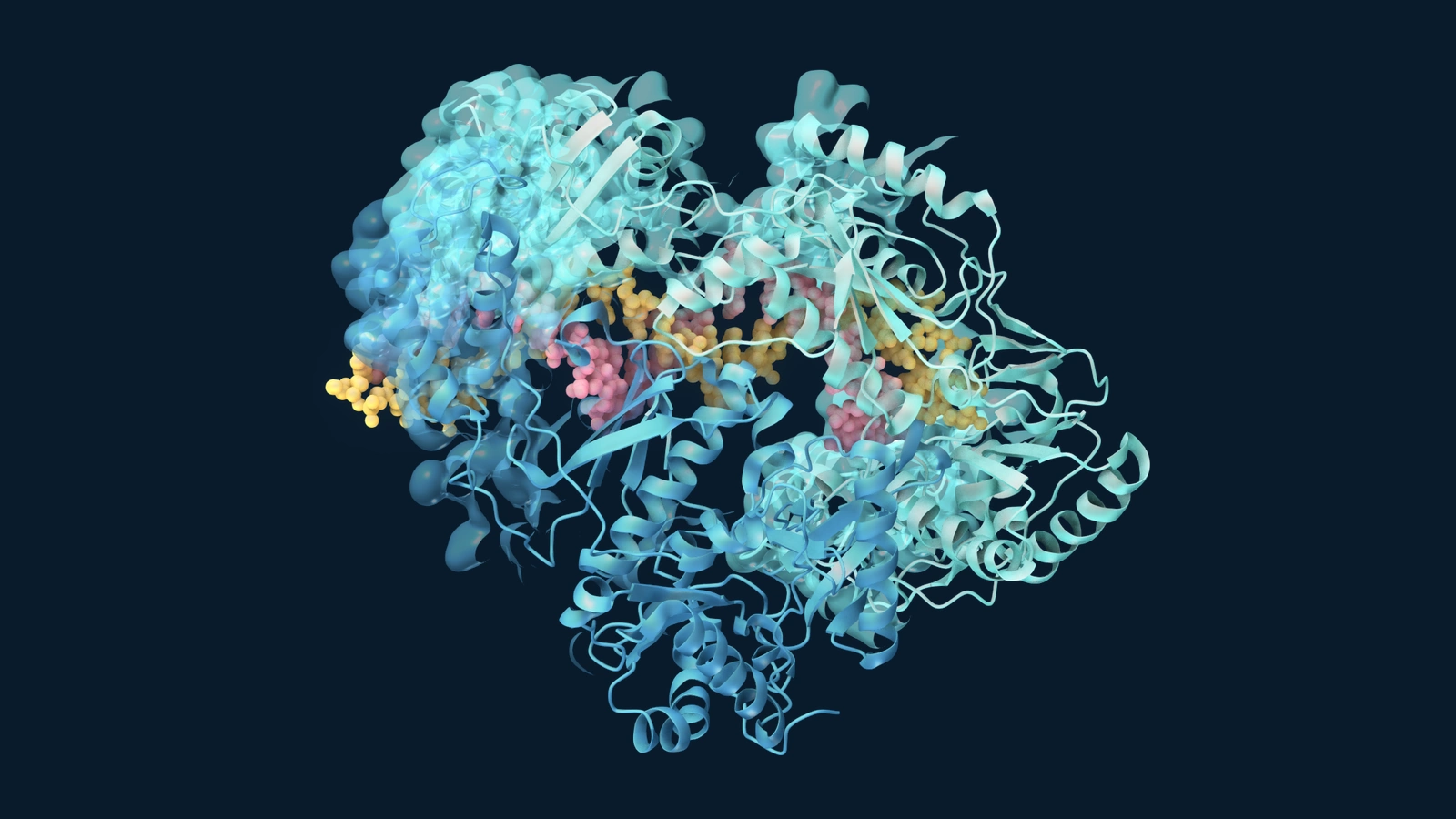
The artwork shows a later example: HIV-1 reverse transcriptase holding a short RNA:DNA hybrid, based on experimental structure PDB 1HYS. Its folded protein parts form a cradle around the genetic strands. The two differently coloured strands make the enzyme’s copying role tangible.
This crystallographic model is a structural snapshot, not a film of copying. An antibody used in the structural study is omitted for clarity. The HIV enzyme is not the original 1970 tumour-virus preparation, and laboratory kits can use other reverse transcriptases.
In our wider history of enzymes and Nobel Prizes, reverse transcriptase sits among discoveries that became tools. Its particular achievement was to make RNA legible to a world of DNA methods. A once-surprising direction of copying is now so useful that its Nobel history can disappear into the routine.
Sources and further reading
- Nobel Prize: the 1975 Physiology or Medicine award and the distinct contributions of its laureates.
- Baltimore, D. (1970). RNA-dependent DNA polymerase in virions of RNA tumour viruses. Nature 226, 1209–1211.
- Temin, H. M. and Mizutani, S. (1970). RNA-dependent DNA polymerase in virions of Rous sarcoma virus. Nature 226, 1211–1213.
- Crick, F. (1970). Central dogma of molecular biology. Nature 227, 561–563.
- National Human Genome Research Institute: complementary DNA.
- CDC: Influenza SARS-CoV-2 Multiplex Assay.
- RCSB PDB 1HYS and its primary structural publication by Sarafianos and colleagues (2001).