Finding a protein that a medicine can act on is an early challenge in drug discovery. DPI_CDF, a computational model described in 2024, approaches that search by looking for patterns in protein sequences. It aims to help researchers identify candidates worth investigating before committing to more demanding experiments.
The study by Muhammad Arif and colleagues, published in BMC Bioinformatics, reported strong classification performance on an independent benchmark. Its results concern recognition of proteins labelled as druggable, rather than proof that an unfamiliar protein would make a useful treatment target. Original study.
How DPI_CDF reads a protein
The model converts an amino-acid sequence into numerical features describing its composition, physicochemical properties and evolutionary conservation. The evolutionary information comes from comparisons with sequences in a protein database. Thus, the method does more than count the amino acids in an isolated sequence.
DPI_CDF combines those features using a cascade deep forest: an ensemble of decision-tree models arranged in successive layers. Information from one layer helps inform the next. Despite the word “deep,” its central classifier is not a conventional deep neural network.
What the independent test showed
The researchers developed the model using 2,542 protein sequences labelled as druggable or non-druggable. They also evaluated it on a separate dataset containing 461 sequences: 224 labelled druggable and 237 labelled non-druggable.
For the best-performing feature combination on that independent dataset, the paper reports 95.01% accuracy and a Matthews correlation coefficient of 0.900. The latter measure takes correct and incorrect predictions in both classes into account.
These figures measure classification against the benchmark labels. They are not the probability that a proposed drug will work. The separate test dataset helps assess performance outside the development set, but does not replace experiments on previously uncharacterised targets.
From a prediction to a useful drug target
A protein can look promising computationally while remaining difficult to influence with a useful drug. Researchers must establish whether a suitable molecule can bind it, whether changing its activity affects the disease process, and whether the intervention can be sufficiently selective and safe.
The labels themselves also require care. A protein classified as non-druggable in a benchmark is not necessarily impossible to target with future technologies. A model learns from the evidence and classification choices available when its datasets were assembled.
For these reasons, DPI_CDF is best understood as a way to prioritise investigation. Its predictions need to be considered alongside structural, biochemical and disease-specific evidence. Our coverage of AlphaFold 2 and enzyme structure discusses a different computational contribution to that evidence base.
A research implementation to evaluate
The authors made benchmark data and source code available through their research repository. In the paper, they acknowledged that constructing the hand-designed features required specialist knowledge, and that the method had not been packaged as a web server or standalone binary.
Independent reproduction, broader datasets and testing on less familiar protein families would help establish where the model is most useful. The study offers a computational filter for drug-target research. It does not demonstrate a new medicine, patient-specific treatment or measured reduction in development costs.
Update note, 27 September 2026: This archived report was revised to explain the model’s inputs, distinguish independent-test results from clinical outcomes, and clarify the research implementation. Its original publication date and URL are retained.
References
- Arif, M., Fang, G., Ghulam, A., Musleh, S. and Alam, T. (2024). DPI_CDF: druggable protein identifier using cascade deep forest. BMC Bioinformatics, 25, 145. DOI: 10.1186/s12859-024-05744-3. Open full text.
- DPI_CDF research code and benchmark data.
Image sources
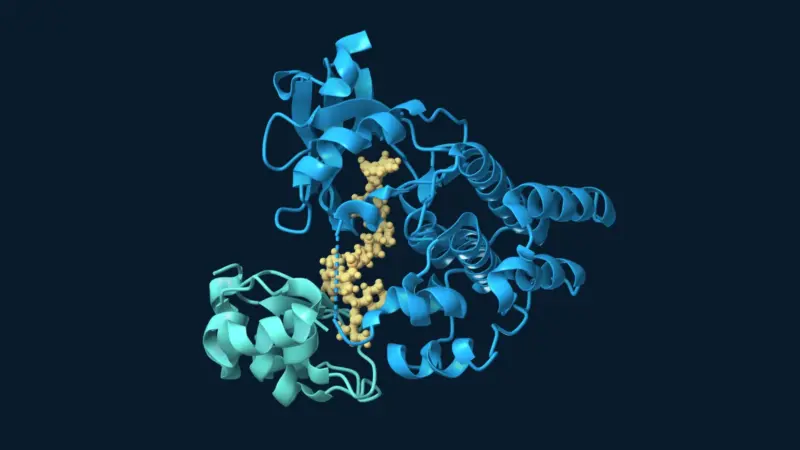
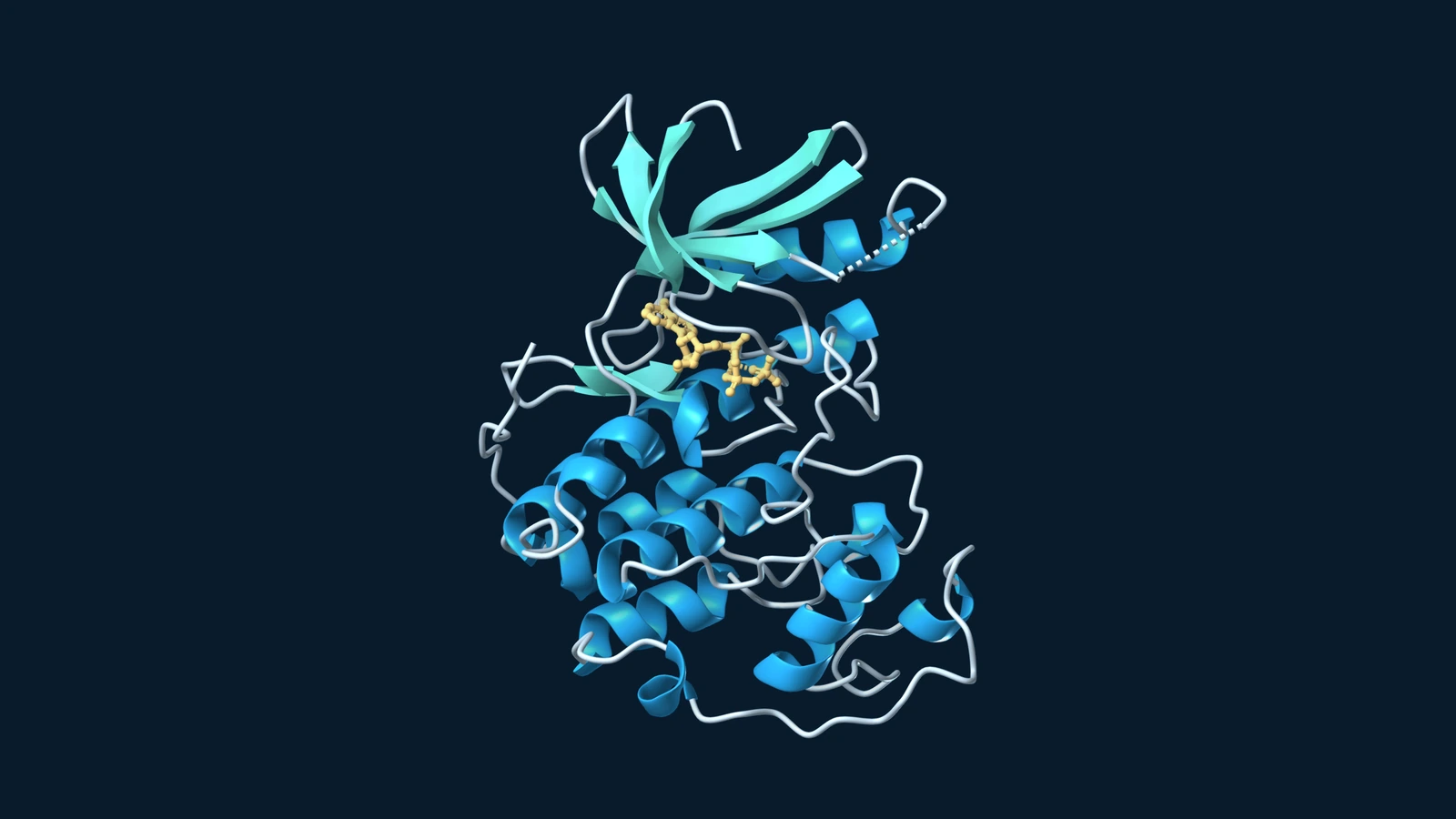
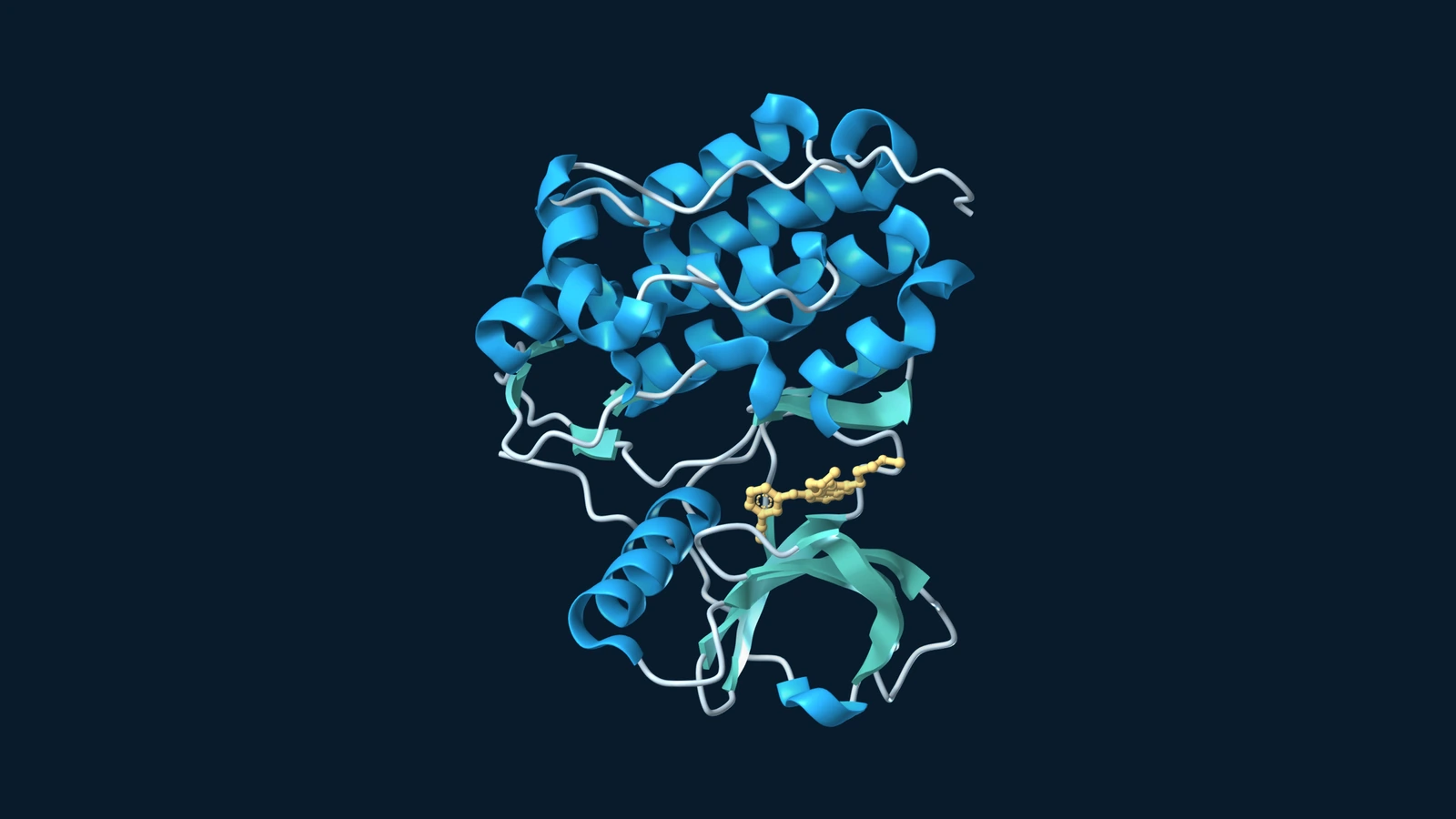
- Structure: PDB 1M17, the epidermal growth factor receptor kinase domain with erlotinib. This illustrates an established protein–inhibitor complex, not a target discovered or validated by DPI_CDF. Stamos, J., Sliwkowski, M. X. and Eigenbrot, C. (2002). Structure of the epidermal growth factor receptor kinase domain alone and in complex with a 4-anilinoquinazoline inhibitor. Journal of Biological Chemistry, 277, 46265–46272. DOI: 10.1074/jbc.M207135200.
- Visualization: original EnzymeNews rendering with Mol*, using RCSB PDB coordinate data. Protein residues beyond author number 960 and water are omitted to emphasise the kinase and bound inhibitor.